The Erasmus+ Programme Guide 2026 was officially published on 12 November 2025 as an integral part of the 2026 Call for Proposals. With a total budget of €5.2 billion for the year, the 2026 programme continues the strategic direction established in the 2021–2027 generation — but brings a set of concrete updates, clarifications and strengthened priorities that directly affect how applications are written, evaluated and scored.
The good news is that the 2026 Guide does not reset the programme. Key Actions, formats and structures remain stable. But inside that stable framework, there are enough changes — to priorities, to KA1 technical rules, to accreditation requirements, to financial regulations and to what evaluators expect to see — that organisations applying with a 2025 mindset will score below their potential. This guide explains what changed, what stayed the same and what you need to do differently.
📋 In This Guide
- Overview: What the 2026 Guide Changes
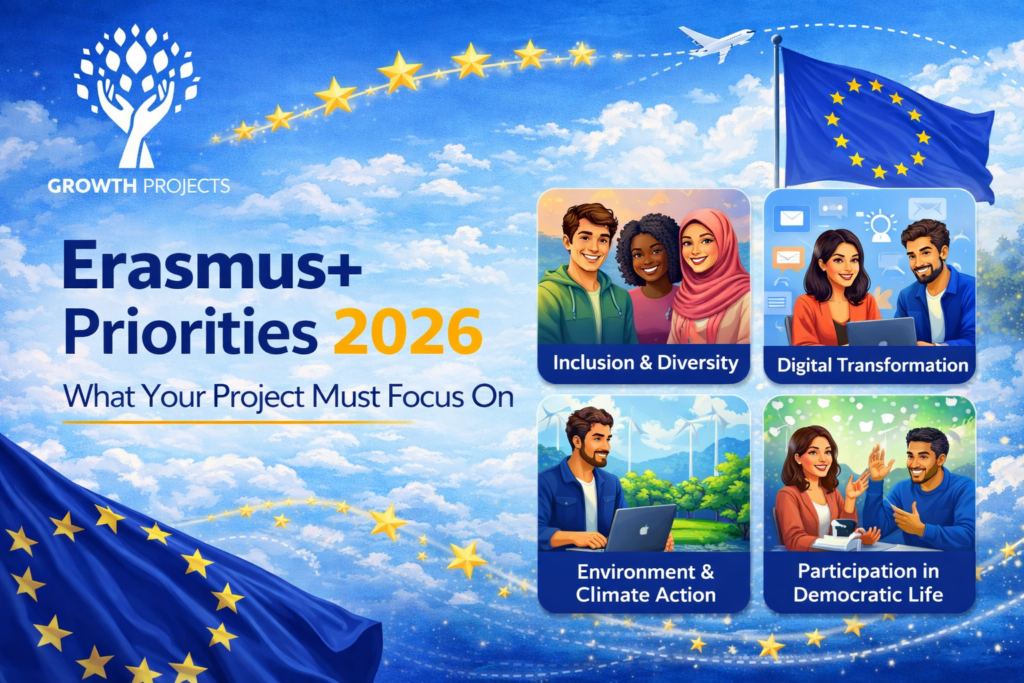
- The Four Horizontal Priorities in 2026
- Key Changes by Key Action
- Accreditation: New Rules and Stricter Standards
- New Financial Regulation: What It Means in Practice
- What Stayed the Same
- What to Do Differently in Your 2026 Application
- 2026 Programme Guide Checklist
1. Overview: What the 2026 Guide Changes
The 2026 Programme Guide brings changes across five main areas. None of them individually transform the programme, but together they shift what a competitive application needs to demonstrate — particularly around the green dimension, mental health, gender equality and the depth with which horizontal priorities must be integrated into the project design rather than mentioned in passing.
| Area of Change | What Changed | Impact on Applications |
|---|---|---|
| Horizontal priorities | Four priorities strengthened — green, digital, inclusion and democratic participation now require explicit, measurable integration | Generic priority mentions no longer score well — evaluators expect specific strategies with measurable indicators |
| Green travel requirement | For trips under 500km, train or other sustainable transport is now the expected default — not just encouraged | KA1 budgets and activity plans must reflect sustainable travel choices; car travel for short distances needs justification |
| Mental health | Mental health explicitly named as a priority for school and VET projects — no longer an optional dimension | School and VET applications that do not address well-being will score below their potential on relevance |
| Gender equality in STEM | The 2026 Guide gives more explicit weight to gender equality in STEM — evaluators want real strategy, not a sentence | Projects in school and VET that mention STEM should describe specific gender equality measures and how they will be measured |
| Accreditation rules | Accreditation can now be terminated if unused for 3 consecutive years; Erasmus Plans must be regularly updated; NAs can conduct more frequent monitoring | Accredited organisations must use their accreditation actively and keep plans current — passive holding is no longer safe |
| Financial regulation | New EU Financial Regulation 2024/2509 now applies to all Erasmus+ actions — clearer but stricter financial rules | Coordinators must follow financial guidelines more precisely; documentation requirements are more explicit |
| New KA240 action | European Partnerships for School Development (KA240-SCH) introduced as a new action for schools with existing KA1 experience | New funding pathway for experienced schools — deadline 9 April 2026; not available to first-time applicants |
| EU policy context | Programme explicitly linked to Union of Skills, Preparedness Union Strategy and micro-credentials framework | Projects referencing these frameworks in their relevance section are better aligned with 2026 evaluator expectations |
2. The Four Horizontal Priorities in 2026
The 2026 Programme Guide maintains the same four horizontal priorities as previous years — but significantly raises the bar for how they must be integrated into applications. A generic sentence stating that a project “contributes to inclusion and diversity” is no longer sufficient. Evaluators in 2026 expect specific strategies, named target groups, concrete measures and — where possible — measurable indicators for each priority that is claimed.
1. Inclusion and Diversity. The inclusion priority focuses on ensuring equitable access and participation for all learners, with particular attention to participants with fewer opportunities — those facing socioeconomic disadvantage, geographic remoteness, disability, cultural differences or health barriers. In 2026, applications that name the specific barriers faced by their target group and describe specific support measures for each barrier score higher than those that describe inclusion in general terms. The inclusion dimension must be present from the needs analysis through to the dissemination plan — not added as a section at the end.
2. Digital Transformation. The digital priority in 2026 encompasses three distinct dimensions: developing digital competences in participants, using AI in education, and integrating digital education strategies at institutional level. For KA2 cooperation projects, this means the intellectual outputs should have a clear digital dimension — not just being published online, but being designed as digital learning resources, tools or methodologies. For KA1 mobility projects, staff training in digital tools and methodologies is explicitly valued.
3. Environment and Climate Change. The green priority is the one that has strengthened most visibly in 2026. The travel expectation for short-distance trips is a concrete operational requirement — not a recommendation. Beyond travel, applications are expected to show how the project itself contributes to green competences, sustainability behaviours or climate literacy in participants. Projects that address environmental education, green skills or climate action as their primary theme are particularly well-aligned with 2026 priorities.
4. Participation in Democratic Life. The democratic participation priority covers civic engagement, media literacy, critical thinking and understanding of EU common values. In 2026 this priority connects explicitly to the Preparedness Union Strategy — the EU’s framework for building resilience in education systems during crises, conflicts and emergencies. Projects that address media literacy, disinformation, democratic participation of young people or civic education have a strong 2026 alignment story to tell.
💡 Name the Priority, Then Show the Strategy
The most effective way to address priorities in a 2026 application is to name the specific priority explicitly, then describe the specific strategy your project uses to address it, then explain how you will measure the outcome. Three sentences per priority — specific, concrete and measurable — score significantly higher than a paragraph of general aspiration. Evaluators are checking for evidence of genuine integration, not keyword presence.
3. Key Changes by Key Action
Beyond the horizontal priorities, the 2026 Guide brings specific changes to individual Key Actions. The table below summarises the most practically significant updates for each action.
| Key Action | Key Changes in 2026 | What to Do Differently |
|---|---|---|
| KA121 — Accredited School, VET, Adult Mobility | Mental health explicitly prioritised for school and VET; green travel expectation for under 500km trips; gender equality in STEM given more weight; Erasmus Plans must be updated and aligned with 2026 priorities | Update your Erasmus Plan to reference 2026 priorities explicitly; add well-being dimension to school projects; review travel plans for sustainability; add specific gender equality measures if STEM is involved |
| KA122 — Short-term Mobility | Same structural rules as 2025; “Courses and training” budget cap of 50% continues; maximum 2 participants shadowing same mentor; each staff member limited to one course per project | Ensure course budget does not exceed 50% of total grant; plan a balanced mix of mobility types; do not build a project entirely around training courses |
| KA152/153/154 — Youth Mobility | Two rounds maintained — February and October; stronger inclusion expectation for participants with fewer opportunities; green travel expectation applies; Youthpass remains mandatory | Name specific fewer opportunities barriers in the application; describe green travel choices for exchanges; integrate Youthpass into the learning programme rather than treating it as an administrative step |
| KA210 — Small-Scale Partnerships | One round per year maintained; lump sum model unchanged; stronger expectation that outputs demonstrate genuine transnational added value; new financial regulation applies | Strengthen the transnational necessity argument; ensure outputs are specific and genuinely collaborative rather than produceable by one organisation alone; follow new financial documentation rules |
| KA220 — Cooperation Partnerships | One round per year maintained; hybrid budget model unchanged; stronger priority alignment expected in relevance section; EU policy context (Union of Skills, micro-credentials) should be referenced where relevant | Reference relevant 2026 EU policy frameworks in the relevance section; ensure all four priorities are addressed specifically; connect outputs to the Union of Skills framework if VET or HED sector |
| KA240 — European Partnerships for School Development (NEW) | Entirely new action introduced in 2026; for schools with existing KA1 experience; deadline 9 April 2026; longer-term strategic cooperation focus | Only apply if your school already has documented KA1 experience; treat this as a strategic institutional partnership rather than a project — the application logic is different from KA210/KA220 |
4. Accreditation: New Rules and Stricter Standards
The 2026 Programme Guide introduces the most significant changes to Erasmus Accreditation since it was introduced in the 2021–2027 generation. Organisations that hold an accreditation — and those planning to apply for one — need to understand these changes before the 29 September 2026 deadline.
Accreditation can now be terminated for non-use. If an accredited organisation fails to use its accreditation for three consecutive years — by not submitting a grant application or not implementing mobility activities — the National Agency can terminate the accreditation. This ends the era of organisations holding an accreditation passively as a credential without actively using it. Accredited organisations must plan their mobility activities and submit grant requests annually.
Erasmus Plans must be regularly updated. The Erasmus Plan — the strategic document at the heart of the accreditation application — is no longer a static document submitted once and left unchanged. The 2026 Guide expects accredited organisations to keep their Erasmus Plan current and aligned with the evolving priorities of the programme. NAs may request updated Erasmus Plans during monitoring visits.
More frequent monitoring visits. National Agencies are now explicitly empowered to conduct more frequent monitoring visits and to request additional reporting from accredited organisations. This is a quality assurance measure — but it means accredited organisations need to maintain project documentation and evidence of activity delivery to a higher ongoing standard than before.
Detailed rules for accreditation transfers. The 2026 Guide introduces specific provisions for what happens to an accreditation when an organisation undergoes a merger, legal restructuring or significant operational change. Previously this was a grey area; the new rules clarify the process and conditions under which an accreditation can be transferred to a successor organisation.
⚠️ Accreditation Is No Longer Automatic — It Must Be Actively Maintained
The 2026 changes shift accreditation from a one-time achievement to an ongoing quality standard. If your organisation holds an accreditation, review your Erasmus Plan against the 2026 priorities, confirm your planned mobility activities for the year and ensure your documentation systems are ready for a potential monitoring visit. If you are applying for accreditation for the first time, the 29 September 2026 deadline is the only opportunity this year — see our 2026 deadlines guide for full deadline details.
5. New Financial Regulation: What It Means in Practice
The EU Financial Regulation 2024/2509, adopted by the European Parliament and Council in September 2024, now applies to all Erasmus+ actions from 2026 onwards. For most applicants the practical impact is moderate — the rules are clearer and more explicit rather than fundamentally different — but there are specific implications worth understanding.
Clearer but stricter documentation requirements. The new regulation makes financial documentation requirements more explicit — what evidence is required for each cost category, how it must be organised and how long it must be retained. For coordinators this means less ambiguity about what is acceptable, but also less flexibility to use informal documentation practices that may have worked under previous rules.
Retention period confirmed at 5 years. The minimum document retention period remains 5 years after the project end date. The new regulation reinforces this requirement and makes clear that it applies to all financial records, output evidence and correspondence related to the grant — not just formal financial reports.
Updated Call IDs. All 2026 Erasmus+ funding calls have new Call IDs under the new regulatory framework. When submitting applications, ensure you are applying to the 2026 Call ID — not the 2025 equivalent. The Beneficiary Module should auto-populate this when you select the correct call year, but always verify before submitting.
6. What Stayed the Same
Alongside the changes, it is important to be clear about what has not changed — to avoid organisations over-correcting or assuming more disruption than there is.
The Key Action structure is unchanged. KA1, KA2, KA3 and Jean Monnet Actions continue in the same format. KA121, KA122, KA152, KA153, KA154, KA210 and KA220 all operate under the same basic rules as 2025. No Key Action has been eliminated or fundamentally restructured for 2026.
Evaluation criteria and scoring are unchanged. The four evaluation criteria — Relevance (30 points), Quality of Project Design (30 points), Quality of Project Team (20 points) and Impact (20 points) — remain the same for KA2 actions. The weighting has not changed. The minimum thresholds have not changed. What has changed is the depth of evidence expected within each criterion for the priority dimensions.
Budget models are unchanged. KA210 continues to use the lump sum model (up to €60,000). KA220 continues to use the hybrid unit cost and real cost model (up to €400,000). KA1 continues to use unit costs for travel, individual support and organisational costs. No budget ceilings have been reduced for 2026.
Partnership requirements are unchanged. KA210 requires a minimum of 2 partners from 2 different programme countries. KA220 requires a minimum of 3 partners from 3 different countries. These minimums have not changed for 2026.
The Beneficiary Module and OID system are unchanged. Applications are still submitted through the Beneficiary Module. OIDs are still obtained through the EU Funding and Tenders Portal. The submission process is identical to 2025.
The 33 programme countries are unchanged. The list of Erasmus+ programme countries — 27 EU Member States plus Iceland, Liechtenstein, Norway, North Macedonia, Serbia and Türkiye — remains the same for 2026.
7. What to Do Differently in Your 2026 Application
Based on the changes in the 2026 Programme Guide, here is the practical guidance for organisations preparing applications for the next call — whether that is the October 2026 youth round, the 2027 KA210/KA220 call or the September 2026 accreditation deadline.
Go deeper on priorities — do not just mention them. The single most impactful change you can make to a 2026 application is replacing general priority statements with specific, strategic ones. For each priority your project addresses, write one paragraph that names the priority, describes your specific approach, and explains how you will measure the outcome. Evaluators in 2026 are explicitly looking for evidence of genuine integration rather than keyword presence.
Address green travel in your activity plan. For any KA1 or KA2 project that includes transnational travel, review the distances involved and plan for sustainable travel options for trips under 500km. If participants are travelling by train rather than plane, say so explicitly in the activity description — this signals alignment with the 2026 green travel expectation and avoids any impression that sustainability has not been considered.
Add mental health and well-being if applying in School or VET. For school education and VET applications in 2026, the well-being dimension is no longer optional. Include a specific reference to how the project addresses or supports the mental health and well-being of participants — whether through the project’s content, its methodology, or the learning environment it creates. This does not require making well-being the primary topic — it requires showing awareness of it as a design consideration.
Reference the 2026 EU policy context in your relevance section. The Union of Skills, the Preparedness Union Strategy and the micro-credentials framework are all named in the 2026 Guide as the wider policy context for the programme. Referencing the most relevant of these in your relevance section — particularly for VET, adult education and higher education projects — signals that your project is embedded in current EU policy thinking rather than existing in isolation from it.
If accredited, update your Erasmus Plan now. Do not wait for a monitoring visit to discover that your Erasmus Plan does not reflect 2026 priorities. Review it against the four horizontal priorities, update the well-being and green dimensions, and ensure your planned mobility activities for 2026 are documented and realistic. Accreditation that is held but not actively used is now genuinely at risk of termination.
Always use the current Programme Guide — not last year’s. Unit cost rates, grant ceilings, Call IDs and specific eligibility rules are updated annually. Any application planned using 2025 Programme Guide data should be reviewed against the 2026 version before submission. Download the 2026 Programme Guide from the official Erasmus+ website and check every figure you have used in your budget planning.
8. 2026 Programme Guide Checklist
- ✅ 2026 Programme Guide downloaded from the official Erasmus+ website — not using 2025 version
- ✅ Correct 2026 Call ID used in the application form
- ✅ All four horizontal priorities addressed specifically — not generically — in the application
- ✅ Each priority addressed with: named strategy + specific measure + measurable indicator
- ✅ Green travel reviewed — sustainable transport planned for all trips under 500km
- ✅ Mental health / well-being dimension included for School and VET applications
- ✅ Gender equality in STEM addressed with specific measures if STEM is part of the project
- ✅ Relevant EU policy frameworks referenced in relevance section (Union of Skills, Preparedness Strategy, micro-credentials)
- ✅ For KA220: transnational added value explicitly argued — outputs not produceable by one country alone
- ✅ For KA210: lump sum tier proportionate to 2026-scale activity plan
- ✅ For accredited organisations: Erasmus Plan reviewed and updated against 2026 priorities
- ✅ For accredited organisations: planned mobility activities documented and submitted to NA
- ✅ Budget figures verified against 2026 unit cost rates — not 2025 rates
- ✅ Financial documentation plan in place — compliant with EU Financial Regulation 2024/2509
- ✅ Document retention plan confirmed — minimum 5 years after project end
📋 Need Support Applying Under the 2026 Programme Guide?
GrowthProjects.eu keeps up with every Erasmus+ Programme Guide update so your application reflects current evaluator expectations — not last year’s standards. From eligibility checks and project concept development to full KA210 and KA220 proposal writing. Over 32 funded projects across 18 European countries.
✅ Check Your Eligibility for the 2026 Call
Free eligibility checker — takes 2 minutes, no sign-up required.